

The way we work is changing, and the hybrid model is now a top choice for London businesses in 2026. According to the CIPD 2025 report, 74% of UK organisations now support hybrid arrangements. This figure signals a permanent shift rather than a temporary solution. This article explores the hybrid work model’s pros and cons to help you make an informed decision, eventually learning how to balance flexibility with a physical presence in the heart of Fitzrovia.
What is the hybrid work model?
The hybrid work model is a flexible structure where employees split their working hours between a physical office and a remote location, typically their home. Recent ONS data from 2025 reveals that 28% of UK employees currently work in a hybrid setup. This is not a “one-size-fits-all” solution. It ranges from “remote-first” policies to structured schedules where teams attend the office on fixed days for collaboration.
Evaluate the benefits of hybrid work
Hybrid working offers transformative potential for modern businesses. Explore the key advantages that help your business grow and keep your employees motivated.
1. Boost team productivity
Contrary to old fears, hybrid teams often outperform office-only ones. Research from 2025 shows that companies with advanced hybrid models see a 17% productivity boost compared to pre-2020 levels. When employees can choose their environment, focusing on deep work at home and collaborative tasks in the office, they work more efficiently. According to the latest Workforce Panel conducted by Perceptyx, 57% of hybrid employees are fully engaged, compared to 49% of in-person and 42% of remote employees.

2. Save business costs
Reducing your physical footprint directly impacts your bottom line. 90% of CEOs cite cost reduction as a primary driver for adopting hybrid models. By shifting to a smaller, more agile office space, businesses can save an estimated $11,000 (£7,800) per employee annually in real estate and utility costs. This capital can then be reinvested into growth or staff development.
3. Attract global talent
Flexibility is a magnet for high performers. In a competitive market, 53% of job seekers consider remote options a key factor when applying, second only to salary. By offering a hybrid model, you expand your talent pool beyond commutable distances. This allows you to hire the best person for the job rather than just the closest.
4. Improve work-life balance
A happier team is a loyal team. 78% of hybrid workers report an improved work-life balance, which directly reduces burnout. By cutting out the daily commute two or three times a week, employees gain back hours for personal time. This leads to higher morale and significantly lower turnover rates.
5. Save operational costs
It isn’t just rent. Hybrid working lowers day-to-day operational expenses. With fewer people in the office daily, costs for supplies, energy, and maintenance drop significantly. Studies estimate that businesses can save over 30% on non-real estate costs by optimising for a hybrid workforce.

6. Lower carbon footprint
Sustainability is no longer optional. Hybrid work is a powerful tool for green business. Research indicates that hybrid schedules can reduce an individual employee’s carbon footprint by 11-29%, primarily by eliminating daily vehicle commutes. This helps your business meet its net-zero targets while actively contributing to a cleaner London.
Four tips to tackle the challenges of hybrid work
While the benefits are clear, the transition is not without risks. Understanding the potential drawbacks helps you learn how to solve them before they impact your team.
1. Prevent social isolation
Without daily “water cooler” moments, employees can feel disconnected. Loneliness is a reported challenge for 50% of home-based workers, which can lead to disengagement. To combat this, you must be intentional about in-office time: use it specifically for social bonding and team building rather than just for independent work.
2. Solve communication gaps
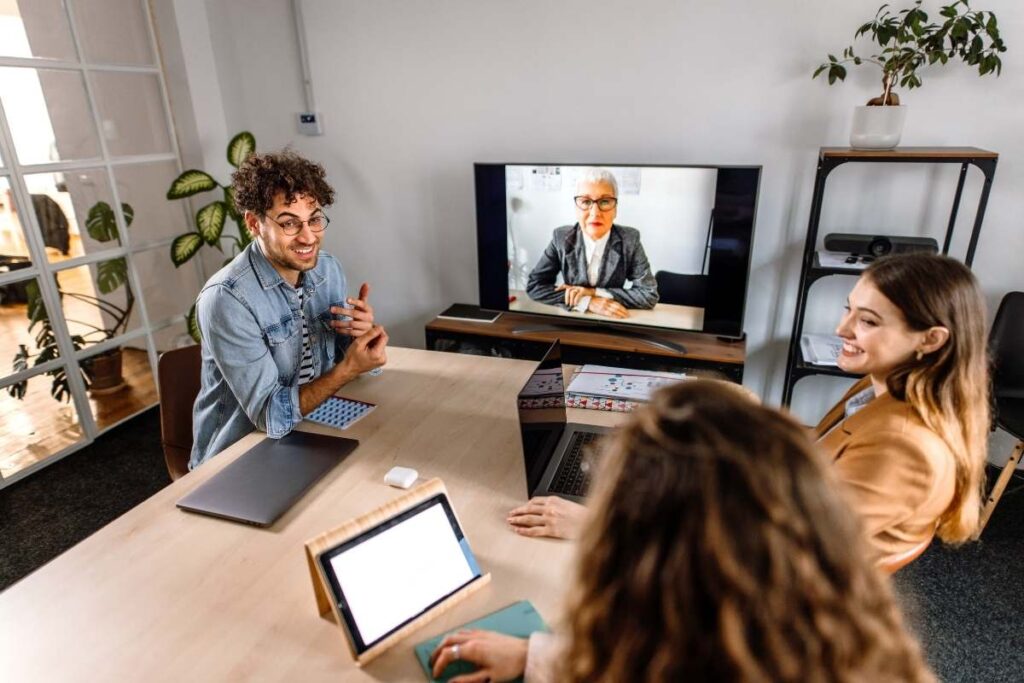
When your team is split, information silos can form easily. If half the room is on Zoom and half is in person, remote participants often feel like “second-class citizens”, leaving remote workers feeling disconnected from critical discussions. Solving this requires a cohesive communication process in which mandatory meetings could be scheduled to avoid a communication gap. You must also invest in high-quality AV tech to ensure everyone has an equal voice.

3. Protect sensitive data
A dispersed workforce expands your cyber attack surface. In 2025, 41% of cyber incidents originated from remote endpoints, often due to unsecured home networks. Mitigating this requires robust security protocols. Mandatory VPNs and regular training are essential to ensure data remains safe regardless of location.
4. Manage complex logistics
Coordinating schedules can become an administrative headache. Knowing “who is in where” is essential to prevent a chaotic office environment. Implementing a simple desk booking system or a clear team rota ensures you optimise your office capacity without overcrowding.
5. Avoid proximity bias
There is a natural tendency for leaders to favour those they see physically. This “proximity bias” can lead to office-based staff getting unfair access to promotions or projects. Managers must be trained to measure performance based on output and outcomes rather than visibility. This ensures a level playing field for all staff.
Start your hybrid office at Gilmoora House
Gilmoora House provides the perfect infrastructure to support a successful hybrid model. We offer the agility you need without the long-term liability of a traditional lease.
How we help you manage varying team attendance:
- Secure private offices for core teams: Provide a permanent base for your leadership or daily staff to collaborate and store sensitive documents. This maintains your company culture and security, ensuring a stable “HQ” feeling even for a distributed team.
- Access high-tech meeting rooms: Our rooms are equipped with premium video conferencing tools. This bridges the gap between home and office, ensuring your remote colleagues feel fully included in every discussion.
- Enjoy a green workspace: Our biophilic design and plant-filled lounges offer a refreshing change from the home office. This actively combats isolation and burnout, making the commute worthwhile for your team.
- Benefit from Fitzrovia’s prestige: A W1 address signals stability to clients. Even if your team is largely remote, this physical presence builds trust and credibility, helping you win bigger contracts.
The hybrid model offers a powerful balance of efficiency and flexibility. However, it requires the right physical base to succeed. By pairing your remote strategy with a professional hub like Gilmoora House, you get the best of both worlds: a content, flexible team and a prestigious, collaborative home for your business.
If you want a workspace that grows with your team, Gilmoora House offers the perfect flexible solution. Contact our Service Team at enquiries@gilmoorahouse.com or call 020 3008 6650.