

Juggling multiple deadlines often feels like being pulled in ten directions at once. The pressure can be overwhelming without a clear structure, affecting both productivity and the quality of your daily tasks. The good news is that you can regain control with direct tactics to organise your workload better.
This guide shares 9 practical project management strategies to help you structure your workflow, organise your daily workload, and manage your time with absolute confidence.
9 strategies to prioritise your workload (even if every task seems to matter)
It is easy to feel drowned when every email and project seems urgent. The key isn’t to work longer hours, but to work smarter. These nine strategies, used by successful project coordinators and team leaders, will help you build a clear plan for the organisation of your workload.
1. Start with clear goals and outcomes for your to-do list
Before you can prioritise a to-do list, you must know exactly what you are trying to achieve. What does “done” look like for your main project? By setting clear goals, you create a filter for every task that comes your way and avoid getting stuck trying to make minor tasks perfect.
For every new request that crosses your desk, apply this three-layer assessment filter:
- Identify the core objective: Does this activity move me closer to my most important goal?
- Evaluate the impact: Will completing this task significantly advance the project, or is it just “busy work”?
- Assign the priority: If the task does not align with your primary outcomes, it should immediately be assigned a low priority.
This goal alignment is the most important first step, ensuring your daily efforts lead to a specific, successful outcome.

2. Use the Eisenhower Matrix to sort your incoming tasks
Eisenhower Matrix is one of the most effective task prioritisation techniques, popularised by former US President Dwight D. Eisenhower. It is a simple tool that helps you sort objectives into four distinct categories based on two evaluation criteria: urgency and importance.
- Quadrant 1: Urgent and Important (Do): These are your critical tasks that need to be done now. This includes crises, immediate problem-solving, or very tight deadlines.
- Quadrant 2: Important but not urgent (Schedule): This is the most crucial quadrant for long-term success. This includes planning, relationship building, and strategic work. You must schedule time for these tasks to prevent them from becoming urgent problems later.
- Quadrant 3: Urgent but not important (Delegate): These are interruptions. They feel pressing but do not contribute to your main goals, such as some emails or meeting requests. If you can, assign these tasks to someone else.
- Quadrant 4: Neither urgent nor important (Delete): These are distractions and time-wasters. Avoid them.
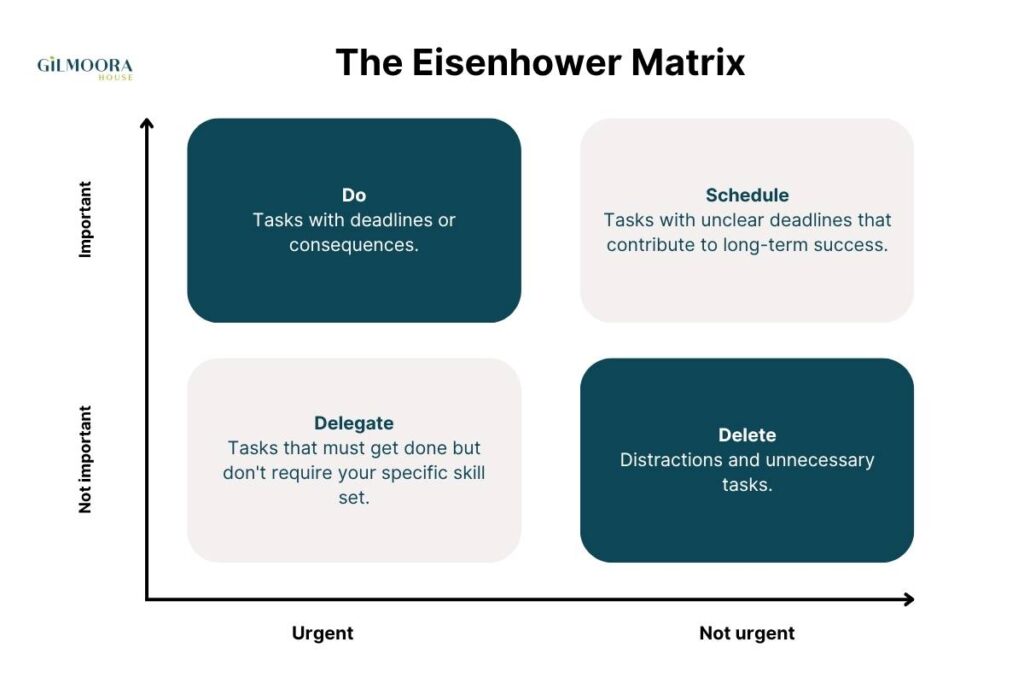
*Source: Adapted from Asana.
3. Break projects into manageable tasks
A large project like “Launch New Website” is too big to prioritise. It’s an outcome, not a task. A project lead will break this down into smaller, highly actionable steps. For example:
- Draft homepage copy: Ensure you include the essential information and tone of your brand.
- Design logo: Create a range of logo formats suitable for different digital and print usages.
- Test contact form: Make sure it functions perfectly to collect user data effectively.
This creates a clean, scannable to-do list and makes it easy to see what needs to happen first. After breaking it down, you can apply the Eisenhower Matrix above to allocate these tasks to suitable specialists. It provides clear milestone tracking, allowing you to see your progress as you complete each small piece.
4. Estimate effort and time accurately
It is hard to plan your day if you think a task will take 30 minutes when it really takes three hours. Being realistic about how long things take is crucial for building an achievable schedule. To do this effectively:
- Foresee scheduled commitments: Always block out your mandatory meetings and appointments first, so you know exactly how many workable hours remain.
- Schedule dedicated focus time: Protect specific blocks of your calendar strictly for deep, uninterrupted work. Ideally, you could spare three to four blocks of 45-minute deep work sessions throughout the workday to utilise the efficiency.
- Buffer for procrastination: Human energy fluctuates. Build in small 10-15 minute buffers between major tasks to account for natural fatigue, context switching, and minor delays.
5. Tackle quick wins to build momentum
When you are unsure how to focus on your workload, start with the “Two-Minute Rule.” If a task takes less than two minutes to complete, such as replying to a quick confirmation email or filing a document, do it immediately. Clearing these low-difficulty, quick tasks early in the day reduces mental clutter and builds a strong sense of momentum for tackling heavier projects.
6. Implement dedicated “Deep Work” sessions
Not all hours are created equal. “Deep work” refers to the ability to focus without distraction on a cognitively demanding task. Identify your peak productivity hours (e.g., early morning or late afternoon) and dedicate this time strictly to your most important tasks. Turn off notifications, silence your phone, and communicate to your team that you are in a focus block.
7. Review and reprioritise regularly
Your plan is not set in stone. A new, urgent task might appear, or a project’s goals might change entirely. A good task manager reviews their priority list regularly. This could be a quick check every morning or a more detailed review at the end of each week. There are two times that you can use to revisit your workload during the day, in the morning or right after lunch break. This allows you to adapt to new information, ensuring you are always working on the most critical item right now.
8. Balance workload across the team
If you are a team leader, prioritisation is not just for you; it’s for the whole team. You must understand who has the capacity to take on new work and who is currently overloaded. Using shared productivity tools or having open, regular check-ins prevents employee burnout, improves team morale, and ensures that tasks are assigned to the person with the right skills and availability.
9. Reflect and improve
The final step is to look back on your work. At the end of a project or a busy week, ask what went well and what did not. Did you estimate your time correctly? Did you get stuck on unimportant tasks? By reflecting on your process, you can continuously refine your prioritisation frameworks, which ultimately saves you valuable time, reduces daily stress, and helps you master your workflow.
Common Mistakes When Prioritising Your Workload
Knowing what not to do is just as important as knowing what to do. Even with the best intentions, it is easy to fall into common traps that derail your progress.
- Taking on simultaneous priorities: It’s a common trap for agency professionals, or those juggling multiple client accounts at once. Attempting to do everything at once leads to split focus, resulting in multiple half-finished projects and nothing being completed to a high standard.
- Reacting only to urgency: Focusing entirely on loud, immediate tasks (like a buzzing inbox) rather than the important, strategic tasks (like quarterly planning) severely hinders long-term business success.
- Failing to communicate shifts: When priorities change, keeping it to yourself causes team-wide confusion, wasted effort on outdated tasks, and major operational frustration.
- Working from static lists: Neglecting regular reviews means you end up executing an outdated plan that no longer reflects your current business goals.
- Ignoring team capacity: Scheduling new tasks without checking your team’s current workload is a guaranteed path to employee burnout, stress, and missed deadlines.

Conclusion
Mastering your workload like a project manager does not happen overnight. It is a skill built on structure, discipline, and the flexibility to adapt. Whether you are working independently or as part of a wider team, effective prioritisation is the key to reducing stress, enhancing your performance, and delivering consistent results. By applying a clear and organised approach, starting with your goals, sorting your daily tasks, and reviewing your progress, you can stay focused on what truly matters.
Find a workplace that helps you stay in control
Your environment plays a massive role in your ability to focus. It is incredibly hard to stay in control of your workload in a chaotic or distracting space.
At Gilmoora House, we provide a premium setting specifically designed to inspire productivity and clear thinking. Our bright, high-tech serviced offices offer a calm, professional space to concentrate, while our in-house IT support and dedicated service team handle the facility details, so you don’t have to. Located in the heart of the vibrant Fitzrovia Quarter, our modern environment gives you the structural support you need to work smarter, not harder.
FAQs
1. How often should I review my workload?
Many project managers do a quick review at the start of each day to set their top 1-3 priorities. They then conduct a more in-depth review at the end of each week to plan for the week ahead. If your work is very dynamic, you might need to check your priority list after every major task.
2. What is the best method for prioritising tasks?
There is no single “best” method; the ideal framework is the one you will use consistently. The Eisenhower Matrix is excellent for sorting tasks by urgency. Another popular method is “Eat the Frog,” where you tackle your biggest, most important task first thing in the morning. For simpler lists, teams often use the “MoSCoW” method (Must have, Should have, Could have, Won’t have).
3. How can I manage competing priorities when everything feels important?
When everything seems like the number one priority, the first step is to communicate. Talk to your team leader or stakeholders and ask for clarification. You can say, “I have both Project A and Project B on my desk, and both are urgent. Could you help me understand which one is the top priority for the business right now?” This brings clarity, manages expectations, and ensures you are applying your effort to what the business needs most.