

Finding the right office space is a key decision for SMEs operating in Central London. With rising occupancy costs and changing workplace expectations, many businesses are weighing the benefits of serviced offices against traditional leases. While both options offer distinct advantages, understanding how they align with your budget, operational needs and growth plans can help you make a more informed decision.
Central London office market overview
Demand for quality workplaces continues to rise across London
Office take-up reached 2.2 million sq ft in Q1 2026, representing a 6% increase compared to the same period last year. At the same time, active demand climbed to a record 14.6 million sq ft, approximately 57% above the 10-year average.
Much of this activity is being driven by businesses seeking room for growth rather than downsizing. Around 47% of occupiers are currently looking to expand their office footprint, while only 15% are seeking to reduce space. Demand is also increasingly concentrated in premium workplaces, with Grade A offices accounting for 92% of leasing activity. This reflects a growing preference for high-quality, well-located office environments that support employee experience and business growth.
Growth of the serviced office sector
The serviced office sector continues to gain momentum as businesses prioritise flexibility and cost control. In Q1 2026, companies entering the London market for the first time, alongside occupiers already using flexible workspace, accounted for approximately 27% of new office demand.
This reflects a broader shift away from traditional long-term leases towards workspace solutions that can adapt to changing business needs. Flexible workspace now represents around 10% of Central London’s office stock, compared with approximately 6% before the pandemic, highlighting its growing role within the market.

For startups, SMEs, project-based teams and businesses establishing a presence in London, serviced offices offer a practical alternative to conventional leases. They provide access to high-quality office space with shorter commitments, allowing companies to scale more easily as their requirements evolve.
Despite the shifts in the commercial real estate sector, the demand for premium flexible workspaces in Central London continues to rise among SMEs.
What’s the difference between a serviced office and a traditional lease
How a serviced office works
A serviced office is a fully furnished, ready-to-use workspace that allows businesses to move in and begin operating immediately. Monthly fees typically include utilities, internet, maintenance, cleaning, furniture and access to shared amenities such as meeting rooms, reception services and breakout areas.
The model is often compared to a hotel stay. Agreements are usually shorter and more flexible than traditional leases, making it easier to increase or reduce space requirements as a business grows or changes.
Traditional lease in London
While traditional lease offers greater control over the workspace, it also requires a higher level of financial commitment and operational responsibility.
Once the lease begins, tenants are generally responsible for arranging utilities, internet services, maintenance and other day-to-day operational requirements.
For established organisations with stable space requirements and long-term growth plans, a traditional lease can provide greater control to strengthen brand awareness without compromising working spaces.
| Serviced Office | Traditional Lease | |
| Setup | Ready to use from day one | Requires fit-out, furniture and IT setup |
| Contract length | Short-term and flexible | Typically 3 to 10 years |
| Upfront costs | Minimal | Six months’ deposit plus legal fees |
| Monthly costs | Fixed and all-inclusive | Variable with utilities and maintenance billed separately |
| Utilities and maintenance | Managed by the provider | Tenant’s responsibility |
| Scalability | Easy to scale up or down | Locked in with subletting required to downsize |
| Risk level | Low with easy exit terms | High due to long-term financial commitment |
| Best suited for | SMEs and project-based teams | Established businesses with stable headcount |
| Cost efficiency | Higher short-term cost | More cost-efficient in the long term at scale |
| Flexibility | High | Low |
What do London SMEs need to consider before choosing?
The right answer depends on where your business stands today and where you expect it to be in the next two to three years. Before committing to either option, there are three key areas every SME should evaluate carefully.
Budget and long-term financial planning
For many SMEs, budget is the first factor shaping the decision between a serviced office and a traditional lease. While a traditional lease may appear more cost-effective per desk over time, the upfront financial commitment is often far higher.
Before making a decision, businesses should consider the full financial picture rather than focusing solely on monthly rent. Key factors include:
- Upfront costs such as rent deposits, legal fees and office fit-out expenses are required before moving into a leased space.
- Ongoing operational expenses, including utilities, internet, cleaning, maintenance, and business rates.
- Office furniture and management costs associated with setting up and running an office independently.
- Future flexibility, particularly if the business needs to expand, downsize or relocate before a lease expires.
- Cash flow requirements, including whether predictable monthly costs or potentially lower long-term occupancy costs better support the company’s financial plans.
Taking these factors into account can help SMEs establish clear benchmarks for evaluating their workspace and more easily identify signs of overspending as their business grows.
Team size and expected business growth
In Q3 2025, Knight Frank reported that almost 300 London office deals were for spaces below 10,000 square feet, driven primarily by startups and SMEs choosing managed and flexible offices that can stretch as headcount rises, rather than committing to long traditional leases.
If your team is growing quickly, locking into a fixed space for five to ten years creates real risk. You may outgrow the office well before the lease expires, potentially forcing the business to relocate earlier than planned or maintain additional premises. In contrast, flexible workspace solutions can adapt more easily as your requirements change, reducing the risk of paying for space that no longer suits the business.

On the other hand, if your headcount is stable and your operational model is well established, a traditional lease can offer better value per desk over the longer term. A useful starting point is to project your headcount 12 to 24 months ahead. If that number carries significant uncertainty, a serviced office gives you room to course-correct without financial penalty.
The importance of flexibility in a changing market
SMEs are increasingly prioritising flexibility, both in terms of office layouts and lease structures, alongside spaces that genuinely support the well-being and day-to-day experience of their teams.
In a market that continues to shift, business requirements can change quickly. Companies may need to accommodate hybrid working arrangements, expand into new markets, reduce headcount or trial a new location. In these situations, the ability to respond promptly can be a significant advantage. For many SMEs, maintaining this flexibility has become just as important as securing the lowest possible occupancy cost.
Businesses that have identified Fitzrovia as a suitable location can then compare the best flexible office spaces in Fitzrovia by amenities, pricing and capacity.

Customisation, branding, and privacy needs
The level of control your business requires over its workspace is another important factor to consider. Traditional leases give tenants full control over office design, branding and layout, allowing businesses to create an environment that reflects their identity. For companies that view their office as an illustration of their brand, this level of customisation can be a significant advantage.
Serviced offices typically offer less flexibility in this area. While they provide a fully equipped and ready-to-use workspace, businesses may have limited control over interior design, and layout changes. Depending on the provider, there may also be privacy considerations when sharing communal facilities with other occupiers.
For SMEs seeking a balance between flexibility and control, managed offices can offer a middle ground. They generally provide greater scope for customisation and branding while still including many of the maintenance and support services associated with flexible workspace solutions, without the full commitment of a traditional lease.
Which option supports faster growth for London SMEs?
For most SMEs in a growth phase, serviced offices offer a clear advantage. Capital that would otherwise be tied up in fit-outs, rent deposits and legal fees can be allocated to the hiring process, product development or market expansion instead. They also provide the flexibility to scale workspace requirements as the business grows, making it easier to respond to new opportunities without being constrained by a long-term lease.
Traditional leases are more rational options e once a business has reached a stable headcount and has a clearer understanding of its long-term space requirements. At that stage, the lower occupancy costs of a conventional lease may outweigh the premium paid for flexibility.
In general, serviced offices support faster growth when speed, capital preservation and adaptability matter most, while traditional leases are better suited to businesses that are ready to commit to a long-term workspace strategy.
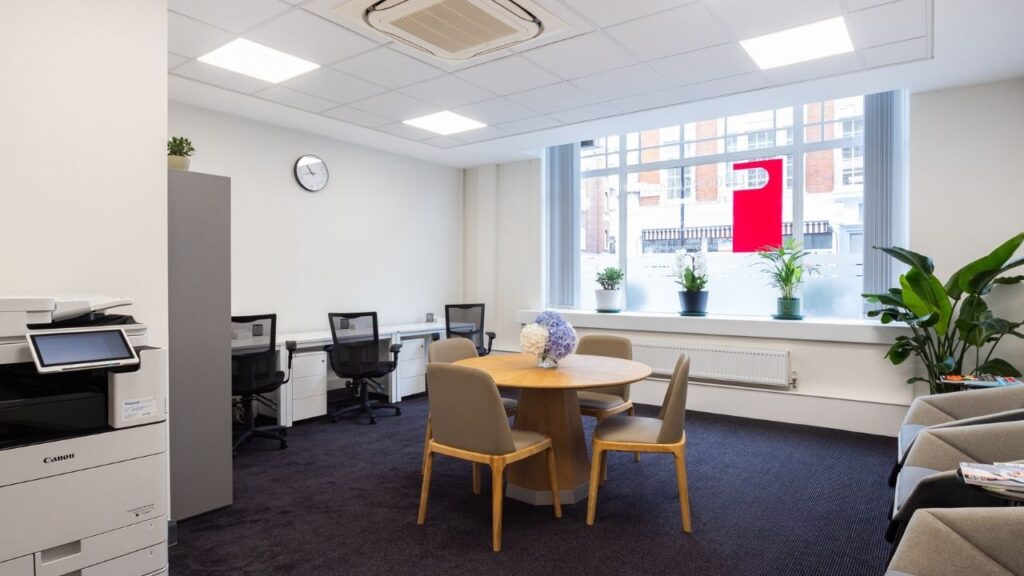
Find the right workspace for your business at Gilmoora House
Finding the right balance between a professional setting and a welcoming atmosphere is key to long-term success. Located in Fitzrovia, Gilmoora House offers flexible workspace solutions for major business needs, including serviced offices and a business lounge designed for coworking and collaborative working sessions.
Why Gilmoora House works for London SMEs:
- Fully furnished offices with natural light, available from 2 to 24 desks upwards with no long-term commitment required.
- Home to diverse business sectors: finance, tech, education, creative hubs, communications, etc.
- High-speed internet, 24/7 access and on-site IT support included as standard
- Meeting and conference rooms, manned reception, telephone answering services and mail forwarding services.
- Stylish breakout areas, a green and calming workspace environment and an on-site service team to keep everything running smoothly
Ready to find an office for your business? Contact our Service Team at enquiries@gilmoorahouse.com or call 020 3008 6650 to book your tour today.
Learn more: